
When shower heads fail in real use—such as leaking, weak pressure, cracking, or uneven spray—it is often assumed that the product simply wears out over time.
In manufacturing reality, however, most of these issues are already introduced during production. They are not random failures, but the result of specific material choices, structural decisions, and process variations that happen inside the factory.
Below are the most common and realistic production-related failure cases seen in shower head manufacturing.
In many cost-optimized production runs, brass components are partially replaced with zinc alloy die-cast parts while maintaining the same external chrome finish.
This substitution is visually difficult to detect because electroplating creates a similar surface appearance. However, the internal mechanical properties are significantly different.
In long-term bathroom environments with constant humidity and temperature changes, zinc alloy tends to develop internal oxidation at stress concentration points, especially around threaded connections.
Over time, this can lead to micro-cracks forming inside the structure. The first visible symptom is often slight loosening at the connection between the shower head and hose, followed by slow leakage under pressure.

In handheld shower heads, ABS plastic is widely used for internal water distribution systems due to its moldability and cost efficiency.
A common production issue occurs when wall thickness is reduced beyond engineering limits to improve injection efficiency or reduce material cost.
In practice, this can lead to slight deformation of internal flow channels after repeated exposure to hot and cold water cycles. Even minor deformation is enough to disrupt water balance inside the chamber.
The user does not see any structural change externally, but the symptom appears as uneven spray patterns, where some nozzles produce stronger flow while others become noticeably weaker.
This issue is particularly visible in entry-level shower head models that prioritize appearance consistency over internal structural reinforcement.
Silicone nozzles are designed to maintain consistent elasticity so that limescale can be removed by simple finger pressure cleaning.
However, in mass production, variations in silicone hardness (Shore A level) can occur due to supplier inconsistency or material batch differences.
When harder silicone is used than originally specified, the nozzle holes do not fully recover after cleaning. This results in slightly distorted spray angles over time.
When softer silicone is used, the nozzle openings may deform permanently under repeated water pressure and manual cleaning, leading to irregular spray direction or partial blockage.
This type of issue is often mistaken by end users as clogging, but in reality it originates from material inconsistency during production.
For this reason, product lines such as those developed by Jekare often implement stricter incoming material verification for elastomer components.
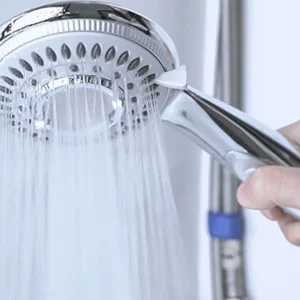
Thread connection accuracy plays a critical role in long-term sealing performance.
During CNC machining, tool wear or batch inconsistency can lead to slight variations in thread depth or pitch accuracy. Even a deviation of less than a quarter millimeter can affect sealing compression.
In factory testing, such products may still pass standard water pressure checks. However, after installation and repeated daily use, micro-vibration gradually reduces sealing efficiency.
This typically results in delayed leakage that appears only after several days or weeks of usage, making it difficult to trace back to manufacturing origin.
Products designed with tighter machining control standards, such as those in Jekare’s shower system range, tend to reduce this risk significantly.
Electroplating is primarily used to improve corrosion resistance and surface appearance. However, plating thickness is not always uniform across complex geometries.
Edges, threaded areas, and internal corners often receive thinner coating due to current distribution limitations during electroplating.
In real use environments, these thinner zones become weak points where moisture can slowly penetrate the coating layer.
Once moisture reaches the base material, corrosion begins underneath the surface rather than on top of it. This leads to bubbling, peeling, or localized rust spots that gradually expand over time.
This type of failure is particularly noticeable in humid environments or regions with hard water conditions.

Sealing performance in shower heads relies heavily on internal O-ring compression.
During assembly, tightening force must be carefully controlled to ensure proper compression without over-deforming the sealing material.
If compression is too low, the seal does not fully engage. If it is too high, the elastomer gradually loses elasticity over time.
In both cases, the result is similar: slow pressure loss or intermittent leakage that only becomes noticeable after repeated thermal cycling between hot and cold water use.
This is one of the most difficult issues to detect during standard factory inspection because initial water testing often shows no abnormalities.
Shower head failures are rarely caused by a single obvious defect. Instead, they are the result of small variations across material selection, machining precision, assembly control, and testing depth.
Each variation may appear minor during production, but together they determine whether a product lasts a few months or several years in real use conditions.
Understanding these manufacturing details also explains why products that look almost identical on the surface can perform very differently in actual bathroom environments.
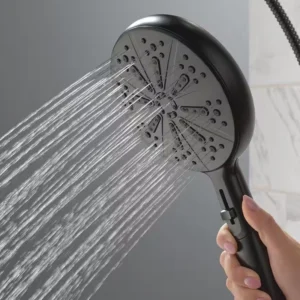
In practical product development, shower head durability is strongly influenced by how well materials and structure are integrated as a system rather than individually optimized.
For example, brass-based handheld shower heads or stainless steel rainfall systems designed with stable internal flow architecture tend to perform more consistently under long-term use conditions. These are also the types of configurations commonly adopted in engineered shower systems developed by manufacturers such as Jekare.
Shower heads usually leak because of worn seals or poor thread sealing. Small assembly gaps can also cause slow leakage over time.
Pressure loss is often caused by internal flow blockage or poor channel design. Sometimes internal parts also deform after long use.
Cheap shower heads use lower-quality materials like zinc alloy or thin plastic. These materials are more likely to crack or loosen over time.
Rust happens when the surface coating is thin or uneven. Moisture can reach the base material and cause corrosion.
It usually happens because of internal wear or design limits. Some problems only appear after long-term use, not in factory tests.
Most defects come from material choice, machining errors, or assembly issues. Small production differences can affect quality.
Inside there are water channels, seals, and flow control parts. These determine pressure and spray performance.
Yes. Manufacturing accuracy directly affects how long a shower head lasts and how stable it performs.