
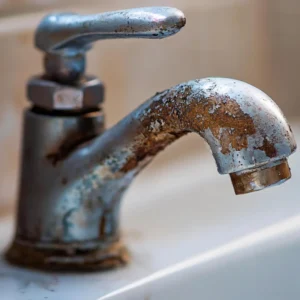
Brass faucets are widely used in plumbing systems because they offer a good balance of cost, machinability, and durability. However, in real water environments, especially those treated with chlorine for disinfection, brass does not simply “wear out” over time. It gradually undergoes an electrochemical degradation process that changes both its surface and internal structure.
The most important mechanism behind this failure is dezincification, a selective corrosion process in which zinc is gradually removed from the brass alloy, leaving behind a weakened and porous copper-rich structure.
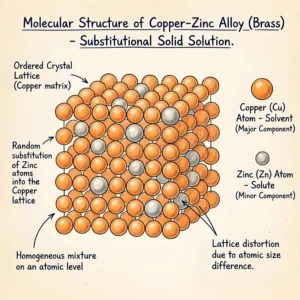
Brass is mainly composed of copper and zinc, and its corrosion behavior in chlorinated water is governed by electrochemical reactions between these metals and oxidizing chlorine species. In water systems, chlorine does not remain as molecular chlorine but forms hypochlorous acid and chloride ions, which create a continuous oxidizing environment.
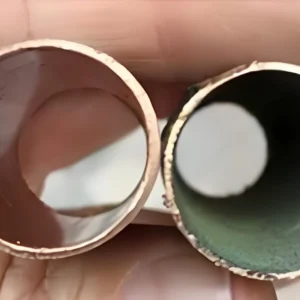
In this environment, zinc becomes the first element to react because it is more electrochemically active than copper. It dissolves into the water as Zn²⁺ ions, while chloride ions stabilize the dissolved zinc and prevent it from redepositing. Over time, this selective removal of zinc gradually changes the internal structure of brass, turning it into a weak and porous copper-dominated matrix that can no longer maintain mechanical integrity.
Chlorinated water is widely used in municipal systems with typical free chlorine concentrations ranging from 0.2 to 1.0 mg/L. While this level is safe for human consumption, it continuously maintains an oxidizing environment inside plumbing systems. This prevents the natural formation of stable protective layers on brass surfaces and keeps the corrosion reaction active over long periods.
As a result, even low concentrations of chlorine can significantly increase the rate of zinc leaching, especially in systems where water remains in contact with metal surfaces for extended periods.
Temperature plays a critical role in accelerating brass corrosion. At lower temperatures below 20°C, the reaction rate remains relatively slow, and corrosion develops gradually over long periods. In typical cold water systems between 20°C and 40°C, the process becomes more noticeable but still progresses at a moderate rate.
However, once the temperature rises above 40°C, corrosion accelerates significantly, and in hot water systems above 60°C, the reaction rate increases sharply due to faster chemical kinetics and higher ion mobility. This is why brass components in hot water lines or recirculation systems tend to fail much earlier than those in cold water systems.
During the corrosion process, zinc ions (Zn²⁺), copper ions (Cu²⁺), and chloride ions (Cl⁻) are gradually released into the water. In most normal residential conditions, these concentrations remain low and are not considered a direct health hazard. However, they can still affect water quality by creating metallic taste, contributing to internal scaling, and increasing the risk of biofilm formation in plumbing systems.
From an engineering perspective, the main concern is not acute toxicity but the long-term degradation of system reliability and water stability.
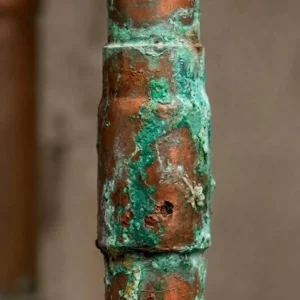
In real-world plumbing systems, corrosion is often more severe than in controlled laboratory conditions because water flow is not always continuous. In low-usage areas or dead-end pipe sections, chlorinated water can remain stagnant for long periods, increasing local chlorine concentration and extending exposure time. Additionally, when brass is connected to other metals such as copper or stainless steel, micro-galvanic cells can form, further accelerating localized corrosion. These real-world conditions make system design just as important as material selection.
To improve the long-term performance of brass faucets in chlorinated water systems, engineers often rely on a combination of material selection, surface protection, and system design optimization. Dezincification-resistant brass (DZR brass) is commonly used because it improves alloy stability under chlorine exposure. Surface treatments such as nickel or chromium plating can also reduce direct contact between brass and water. In addition, system-level improvements such as reducing stagnant zones and maintaining stable water flow can significantly slow down corrosion progression.
Corrosion in brass faucets exposed to chlorinated water is fundamentally an electrochemical process driven by selective zinc leaching and accelerated by chlorine chemistry, temperature variation, and long-term water exposure. However, the severity of this degradation is rarely determined by material composition alone. It is strongly influenced by real plumbing conditions such as water stagnation, system design quality, flow dynamics, and thermal cycling behavior.
This means that improving long-term durability cannot rely solely on upgrading material grade. It requires a system-level approach that considers both environmental conditions and engineering design parameters.
In practical applications, especially for commercial and OEM projects, this is where material selection and manufacturing strategy must align. At Jekare, we provide OEM and private-label manufacturing for high-quality brass faucets designed with corrosion resistance and system compatibility in mind, allowing clients to build products that are adapted to real operating conditions rather than theoretical standards alone.
Q1: Why do brass faucets corrode in chlorinated water?
Because chlorine creates an oxidizing environment that causes dezincification, where zinc is selectively removed from brass over time.
Q2: Is chlorinated water harmful to brass faucets?
It is not immediately harmful, but long-term exposure slowly accelerates corrosion in brass components.
Q3: Does hot water increase corrosion?
Yes. Higher temperatures speed up chemical reactions, and corrosion becomes much faster above 40–60°C.
Q4: What is dezincification?
It is a process where zinc is leached out of brass, leaving a weak, porous copper structure behind.
Q5: Are released metal ions dangerous?
In normal systems, zinc and copper levels are low and mainly affect taste and scaling, not acute health safety.
Q6: How can brass corrosion be reduced?
Using DZR brass, applying protective coatings, and avoiding stagnant or high-temperature water conditions helps reduce corrosion.