
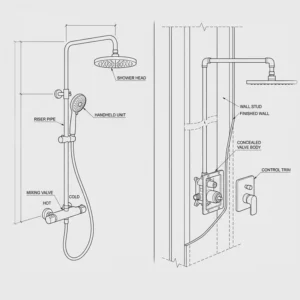
Exposed and concealed shower systems are often compared from a design perspective, but in real engineering applications, they represent two fundamentally different system structures. The differences are not only visual; they directly affect water performance, installation precision, maintenance effort, and long-term operating cost.
Exposed systems provide direct access to all functional components, including valves, cartridges, and diverters. Because everything is installed externally, maintenance work can be completed without disturbing the wall structure. In typical field conditions, service time ranges from 30 to 90 minutes, and no restoration work is required after replacement. This makes maintenance behavior relatively predictable across different project types.
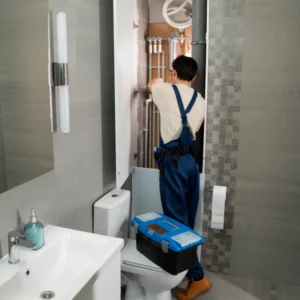
Concealed systems, however, place all critical components inside the wall cavity. As a result, maintenance requires either a dedicated access panel or partial wall opening. In practical applications, repair time is usually extended to 4 to 10 hours, depending on finish materials and installation conditions. In addition, wall restoration—such as tile replacement and waterproof layer repair—is often required, which significantly increases total service effort beyond the mechanical repair itself.
From a fluid performance perspective, exposed systems generally offer a more direct flow path. With standard inlet pressure between 2.5 and 3.0 bar, pressure loss typically remains within 0.05 to 0.15 bar. This relatively low resistance contributes to stable and consistent flow performance, even in systems with moderate pressure fluctuations.
Concealed systems introduce longer internal flow paths within the wall structure. Additional fittings, directional changes, and extended pipe routing all contribute to increased hydraulic resistance. As a result, pressure loss typically ranges from 0.15 to 0.35 bar. In many real-world installations, this corresponds to a 15% to 35% reduction in flow efficiency, particularly in low-pressure or multi-floor supply systems.
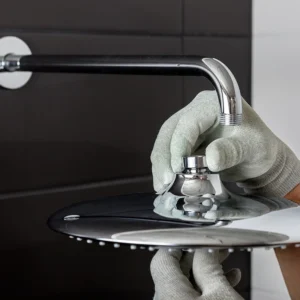
Exposed systems are generally more flexible during installation. Minor deviations in pipe alignment or wall positioning can often be corrected using external fittings or adjustable connectors. The system typically allows an installation tolerance of approximately ±10 to 15 mm, making it suitable for a wide range of on-site conditions, including retrofit projects.
Concealed systems require significantly higher installation precision. Since the valve body and outlet positions are fixed within the wall structure before finishing, alignment must be accurate at the pre-installation stage. The effective tolerance range is typically limited to ±2 to 3 mm. Any deviation beyond this range may lead to misalignment of trim components or compromised sealing performance, making installation coordination between trades an important factor.
In exposed systems, waterproofing requirements are relatively straightforward because most hydraulic connections remain outside the wall. The number of penetration points is limited, and any leakage is generally visible at an early stage, which simplifies troubleshooting and repair.
Concealed systems require a more complex waterproofing strategy due to multiple hidden connection points inside the wall structure. These interfaces depend heavily on installation quality and material continuity. Field experience shows that leakage issues are more commonly associated with interface sealing or waterproofing layer defects rather than valve body failure itself. Once a failure occurs, repair typically involves both plumbing correction and reconstruction of the affected wall layers.
Exposed systems have a relatively linear cost structure, with expenses concentrated in the valve assembly and standard installation work. Because maintenance is straightforward and does not involve structural restoration, lifecycle costs remain stable over time and are easier to predict.
Concealed systems involve a layered cost structure that includes rough-in components, additional waterproofing work, higher installation precision requirements, and potential restoration costs during maintenance. When evaluated across the full lifecycle, total cost is typically 1.8 to 3.5 times higher than exposed systems, depending on project conditions and installation quality.
The key difference between exposed and concealed systems is not appearance, but system complexity distribution. Exposed systems keep complexity outside the wall, which improves serviceability and reduces maintenance uncertainty. Concealed systems shift complexity into the wall structure, improving visual integration but increasing sensitivity to installation accuracy and long-term maintenance effort.
Both systems are technically valid, but they respond differently to real-world construction and operating conditions.
At jekare, system development focuses on how shower components perform under real installation and usage conditions, not just laboratory specifications. Particular attention is given to flow path efficiency, installation tolerance design, and serviceability structure. For concealed systems, small improvements in internal flow geometry or installation allowance can have a measurable impact on long-term system stability in field applications.
Exposed systems keep all parts outside the wall, while concealed systems hide the valve inside the wall.
Exposed systems are easier. Repairs take 30–90 minutes vs 4–10 hours for concealed systems.
Yes. Concealed systems typically lose 0.15–0.35 bar pressure due to longer internal piping.
Concealed systems are used for design-focused hotels, while exposed systems are preferred for easy maintenance.
Yes, mainly due to hidden connections and waterproofing layers inside the wall.
Because of higher installation precision, waterproofing work, and more complex maintenance.