
Most faucet performance issues are not caused by manufacturing defects, but by improper sizing between faucet geometry and sink conditions. Problems such as water splashing out of the basin, unstable stream behavior, or incorrect landing position are almost always the result of a mismatch between faucet spout reach, height, flow rate, and sink depth.
From an engineering perspective, faucet selection should never be based on appearance alone. Instead, it must follow a controlled hydraulic logic that ensures water lands at the optimal position inside the basin under real-world pressure conditions. This becomes even more critical in global projects, where different regional plumbing systems significantly affect performance behavior.
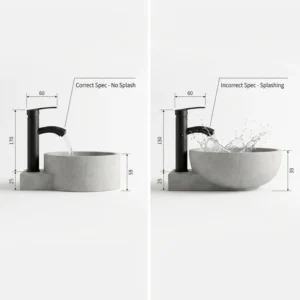
The most critical parameter in faucet-sink matching is the water impact position inside the basin.
In most engineered bathroom systems, the optimal impact zone is located at approximately 40% to 60% of the basin depth measured from the rear wall. This position ensures stable handwashing space, minimizes back-wall splash rebound, and reduces front-edge overflow risk.
If the faucet spout reach is too short, water impacts the rear wall and rebounds unpredictably. If it is too long, water shifts toward the front edge, increasing overflow risk. Therefore, spout reach should always be selected based on sink depth and internal geometry rather than sink width or visual alignment.
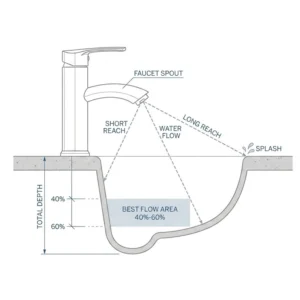
Although sink size is often described by width, actual faucet performance depends primarily on basin depth and internal contour.
Typical engineering reference ranges include:
In shallow basin designs, reducing spout reach by approximately 10% can significantly improve splash control without affecting usability.
Spout height directly influences water velocity at the point of impact, which determines splash behavior and user comfort.
Lower faucet heights reduce impact energy and are more suitable for compact sinks. Higher faucets improve usability but increase splash risk if not properly balanced with flow control and aeration design.
Typical engineering ranges are:
However, increasing height without adjusting flow rate or aerator design leads to unstable stream behavior. Proper system design requires all three parameters—height, flow, and aeration—to be balanced together.
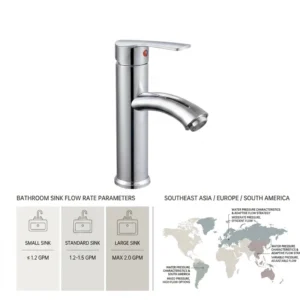
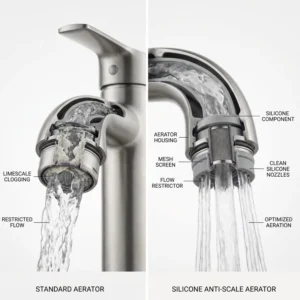
The aerator is a critical functional component that defines how water exits the faucet. Aerated flow is generally preferred because it softens the stream, reduces turbulence, and adapts well to pressure variation. Laminar flow may provide a cleaner visual stream but is less forgiving in shallow or compact basins. Material selection becomes especially important in regions with hard water, where mineral buildup can quickly degrade performance. Anti-limescale silicone aerators help maintain consistent flow by resisting deposits and allowing easy cleaning, which directly improves long-term reliability in B2B applications. In practice, many field performance issues attributed to “low quality faucets” are actually caused by inadequate aerator design or material choice.
Faucet performance is strongly influenced by regional infrastructure, which means a design that works well in one market may underperform in another. In Southeast Asia, compact sink sizes combined with variable pressure require short reach, controlled flow, and effective aeration to prevent splash. In Europe, regulated pressure and efficiency standards shift the focus toward precision in flow shaping and consistency. In South America, where pressure conditions can vary widely, faucet designs must tolerate fluctuations without losing stability, making balanced flow and robust internal design more important than pushing maximum output. These differences are not stylistic—they are driven by real operating conditions and must be accounted for during specification.
In practice, nearly all common faucet problems can be traced back to mismatched geometry. Splash at the front edge indicates excessive reach, while water hitting the back wall signals insufficient reach. Excessive splash despite correct positioning usually points to excessive height or poor aeration. Unstable or noisy flow is typically the result of poor internal flow paths or pressure mismatch. Each of these issues has a clear mechanical cause, and each can be corrected through precise adjustment of reach, height, or flow control. This is why visual design alone is never a reliable basis for specification.
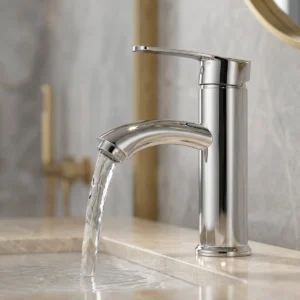
A faucet should be treated as a controlled water delivery system, not a decorative fixture. When spout reach, height, and flow are matched to sink geometry and regional conditions, performance becomes predictable and consistent. For B2B projects, this predictability reduces complaints, simplifies installation, and protects long-term product value across different markets.
At Jekare, we support OEM and project clients by optimizing key components such as flow control structures and anti-limescale silicone aerators, helping ensure consistent performance across different sink configurations and regional water conditions.

Faucet size should be matched based on sink depth and internal geometry, ensuring water lands at the optimal central impact zone inside the basin.
Typical ranges are 3–4 inches for small sinks, 4–5 inches for standard sinks, and 5–7 inches for large sinks.
Excessive splash is usually caused by incorrect spout reach, excessive faucet height, or poor aerator design.
Higher faucet height increases water impact energy, which can increase splash unless flow rate and aeration are properly controlled.
Small sinks require ≤1.2 GPM, standard sinks 1.2–1.5 GPM, and large sinks up to 2.0 GPM depending on basin depth.