
Faucet cartridge failure is usually not caused by a single defect. In most real-world cases, cartridges fail early due to hard water buildup, pressure fluctuations, debris inside pipelines, poor material selection, or incorrect installation.
If your faucet is leaking, getting stiff, or losing temperature control within a short time, the root cause is often a mismatch between the cartridge design and the actual plumbing system conditions—not just product quality.
One of the most common reasons a faucet cartridge fails quickly is water quality, especially in regions with hard water or high chlorine levels. When water contains high concentrations of calcium and magnesium, mineral deposits gradually accumulate on the ceramic disc surfaces inside the cartridge. Over time, this scaling disrupts the ultra-smooth sealing interface, leading to leakage, increased friction, and difficulty in operation.
At the same time, chlorinated water used in municipal systems can chemically attack rubber seals. Materials like standard EPDM begin to lose elasticity under long-term chlorine exposure, eventually cracking or hardening. Once the seal loses flexibility, the cartridge can no longer maintain proper sealing pressure.
In more aggressive environments, such as coastal areas, chloride ions can even trigger corrosion in internal metal components, further accelerating failure. This is why many “good quality” cartridges still fail early—they are not designed for the actual water conditions they are used in.
If your faucet cartridge keeps failing, unstable water pressure may be the hidden cause. In many plumbing systems, especially in high-rise buildings or poorly regulated networks, pressure is not constant. Sudden valve closures can create water hammer, generating pressure spikes far beyond normal operating levels.
These pressure surges place extreme stress on internal cartridge components. Ceramic discs may develop micro-cracks, seals can deform, and internal springs may fatigue prematurely. The damage is often invisible at first, but after repeated exposure, the cartridge starts leaking or loses smooth control.
Even if your system appears to work normally, ongoing pressure fluctuations can shorten cartridge lifespan significantly. This is a typical example of a system issue being mistaken for a product defect.
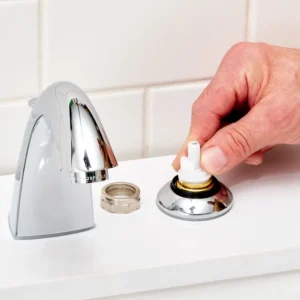
Another major reason for early cartridge failure is debris inside the water supply. During installation or maintenance, particles such as sand, metal fragments, rust, or pipe residue often remain in the system. Once water starts flowing, these particles are carried directly into the cartridge.
Inside the cartridge, especially in ceramic disc types, even tiny particles can cause permanent damage. When trapped between sealing surfaces, they act like abrasives, scratching the ceramic and destroying the sealing integrity. Unlike rubber seals, ceramic surfaces cannot recover once damaged, so even minor scratches can lead to continuous dripping.
This is why many users experience leaks shortly after installing a new cartridge. The issue is not the cartridge itself, but contamination that was never removed from the pipeline.
Not all faucet cartridges are built to the same material standards, even if they look identical from the outside. In cost-driven supply chains, manufacturers may use lower-grade ceramics, less durable rubber compounds, or suboptimal metal components to reduce production costs.
Lower-density ceramic discs wear faster under repeated use, while non-resistant rubber materials degrade quickly in chlorinated water. Springs made from lower-grade stainless steel can lose tension over time, affecting internal balance and sealing performance.
The problem is that these material differences are not immediately visible. A cartridge may pass initial testing but fail much earlier in actual use. This is one of the main reasons why some low-cost cartridges result in higher long-term replacement and maintenance costs.
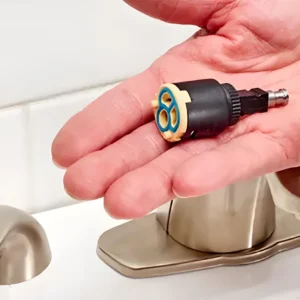
Beyond materials, the internal design of the cartridge plays a crucial role in how long it lasts. If the internal structure does not distribute force evenly across the ceramic discs, certain areas will wear faster than others. This uneven stress leads to localized failure and eventual leakage.
In addition, poorly designed flow paths can create turbulence or cavitation inside the cartridge. Over time, these flow instabilities cause internal erosion and reduce performance consistency.
Modern high-end cartridges are engineered using simulation tools to ensure balanced force distribution and stable flow behavior. Without this level of design optimization, even high-quality materials cannot prevent early failure.
Improper installation is another overlooked reason why faucet cartridges fail prematurely. If the cartridge is over-tightened during installation, the housing can deform slightly, affecting internal alignment. Misalignment leads to uneven wear and reduced sealing efficiency.
In many cases, pipelines are not flushed before installation, allowing debris to immediately enter the cartridge. Additionally, compatibility issues between the cartridge and valve body can create internal stress points that accelerate wear.
Even a well-designed cartridge can fail quickly if it is installed in a system that does not meet basic operating conditions.
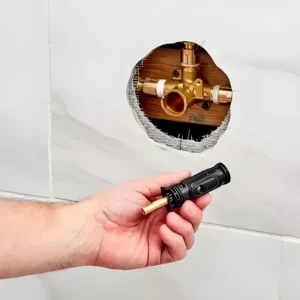
In shower systems, cartridges are constantly exposed to hot and cold water cycles. These temperature changes cause materials inside the cartridge to expand and contract at different rates. Over time, this creates internal stress between ceramic, metal, and rubber components.
As thermal cycling continues, seals begin to fatigue, and small gaps may form at sealing interfaces. This gradually reduces sealing performance and leads to leakage.
In thermostatic cartridges, the complexity is even higher, as temperature-sensitive components must maintain accuracy under changing conditions while also resisting scale and chemical exposure.
If you want to extend the lifespan of your faucet cartridge, the solution is not just replacing it with a new one. The key is addressing the system conditions that cause failure in the first place.
Improving water quality through filtration can significantly reduce scaling and debris damage. Stabilizing water pressure helps prevent internal stress and shock damage. Selecting cartridges with materials matched to local water conditions ensures long-term durability. Proper installation practices, including pipeline flushing and correct torque control, further reduce early failure risks.
In other words, cartridge lifespan depends on the entire plumbing system—not just the component itself.
Conclusion: Cartridge Failure Is a System Issue, Not Just a Product Problem If your faucet cartridge keeps failing, the root cause is rarely just the cartridge itself. Water quality, pressure conditions, debris contamination, materials, and installation all work together to determine performance. For OEM brands, distributors, and engineers, understanding these factors is the key to reducing failure rates and improving long-term reliability. A well-designed cartridge can only perform as well as the system it operates in. Aligning product engineering with real-world conditions is the only way to truly solve early failure problems.
At Jekare, we apply this system engineering approach in cartridge development, focusing on durability under different water and pressure conditions. Related solutions are designed to support different application requirements and can be explored for full system integration.
How long should a faucet cartridge last?
A high-quality faucet cartridge typically lasts 5–10 years under normal conditions. However, in areas with hard water or unstable pressure, it may fail much sooner.
Why does my faucet still leak after replacing the cartridge?
This is usually caused by debris inside the valve body, improper installation, or damage to the sealing surface rather than the new cartridge itself.
Can hard water damage a cartridge?
Yes. Hard water creates mineral buildup on ceramic discs, which leads to sealing failure and increased friction over time.
How do I know if my cartridge is bad?
Common signs include dripping water, stiff handle movement, inconsistent temperature control, or reduced flow performance.
Should I replace or clean a cartridge?
If the issue is caused by debris or minor scaling, cleaning may help temporarily. However, if the sealing surfaces are scratched or worn, replacement is necessary.