
Picture this: You step into the shower after a long day, turn the handle, and… boom—icy cold water hits you like a wake-up call you definitely didn’t sign up for. A second later, it flips to scorching hot. Congratulations, you’ve just experienced the hidden complexity of your shower faucet in action.
That daily moment isn’t random. Behind the wall, your shower faucet is performing a delicate balancing act—controlling pressure, temperature, and flow with surprising precision. Once you understand how it works, you’ll never look at a shower the same way again.

A shower faucet isn’t just an on-off switch—it’s a control system. Its job is to regulate how much water flows, how hot or cold that water is, and where it goes once it leaves the pipe. All of this happens through internal components that most people never see, yet rely on every single day.
The main valve is where everything starts. Located inside the wall, it connects your hot and cold water supply lines and controls how they mix. When you turn the handle, you’re essentially opening this valve and allowing water to pass through. The valve determines both the volume of water and the ratio of hot to cold, making it the foundation of the entire system. When water temperature behaves unpredictably, this is often where the issue originates.
Inside the valve sits the cartridge, which acts as the control core of the faucet. In modern systems, this is typically a ceramic disc cartridge, designed with ultra-smooth, wear-resistant surfaces that regulate water flow with high precision. As you adjust the handle, the cartridge shifts to control both flow rate and temperature mix. Compared to older compression systems, ceramic cartridges last significantly longer and provide smoother operation without dripping or leaking.
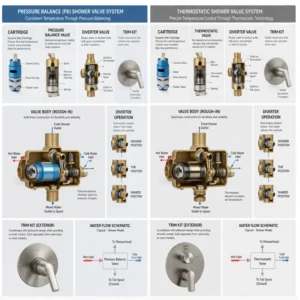
A pressure balance valve is designed to prevent sudden temperature swings caused by changes in water pressure. For example, when someone flushes a toilet and reduces the cold water supply, this valve automatically adjusts the internal balance to maintain a consistent mix. It works by reacting to pressure differences rather than actual temperature, which means it stabilizes the experience but doesn’t lock in a specific temperature setting.
A thermostatic valve takes things a step further by actively controlling temperature. Instead of reacting to pressure changes alone, it uses a temperature-sensitive element—typically wax—that expands or contracts in response to heat. This allows the system to continuously adjust the mix of hot and cold water to maintain a precise temperature, even if supply conditions fluctuate. The result is a much more stable and comfortable shower, along with enhanced safety against scalding.
The diverter valve determines where the water flows once it leaves the main valve. In simple systems, it switches between a bathtub spout and a showerhead. In more advanced setups, it can route water between multiple outlets such as overhead showers, hand showers, or body jets. Depending on the design, the diverter may operate through a push-button mechanism or a rotating control, with higher-end systems offering smoother and more refined switching.
The trim kit is the visible part of the shower faucet—the handle, faceplate, and controls you interact with daily. While it may appear purely aesthetic, it plays an important functional role by connecting user input to the internal valve system. In many markets, especially North America, the trim and the valve body are sold separately, allowing for easier upgrades without opening the wall.
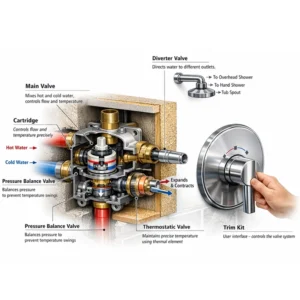
When you turn on your shower, a sequence of events begins instantly. The handle opens the valve, allowing water to flow from both hot and cold supply lines. These streams enter the valve body, where the cartridge regulates their proportion and flow. At the same time, either a pressure balance or thermostatic system stabilizes the output to prevent fluctuations. If multiple outlets are available, the diverter directs the water to the selected function. Finally, the mixed and controlled water exits through the showerhead, delivering the experience you feel.
Although often confused, pressure balance and thermostatic valves serve fundamentally different purposes. A pressure balance valve maintains stability by adjusting to changes in water pressure, making it a cost-effective solution for standard applications. However, it does not guarantee a fixed temperature. In contrast, a thermostatic valve actively controls and maintains a precise temperature regardless of pressure or supply fluctuations. This makes it the preferred choice for high-end residential projects, hotels, and markets with stricter safety requirements. Understanding this distinction is essential when selecting or specifying a product.
Most shower issues can be traced back to internal components. Fluctuating temperatures often result from pressure imbalance or mineral buildup inside the valve. Persistent dripping usually indicates a worn cartridge or degraded sealing components. Reduced water flow is commonly caused by debris or scaling, while diverter failures are typically linked to hardened O-rings or internal blockages. Knowing how the system works makes diagnosing these problems much more straightforward.
For professionals in sourcing, construction, or product development, the details go far beyond basic functionality. Compatibility between rough-in valves and trim kits is critical for installation and future maintenance. Thread standards such as NPT and BSP must be matched correctly for different markets. Material selection impacts durability and corrosion resistance, while certifications determine whether a product can legally enter specific regions. These factors play a key role in both performance and market acceptance.
A shower faucet may look simple, but it’s a highly engineered system designed to deliver consistency, safety, and comfort under constantly changing conditions. Every turn of the handle triggers a coordinated process involving pressure control, temperature regulation, and flow management—all happening in real time.
For manufacturers and buyers alike, understanding this system isn’t just technical knowledge—it’s a competitive advantage. At Jekare, we apply this level of engineering insight to develop shower faucet systems tailored for global markets, from reliable pressure balance solutions to precision thermostatic designs. Because in the end, a great shower experience isn’t accidental—it’s engineered.
Q1: A pressure balance valve adjusts to pressure changes, maintaining stability, while a thermostatic valve controls and maintains a precise temperature regardless of pressure fluctuations.
Q2: Temperature fluctuations are often caused by a pressure imbalance or mineral buildup inside the valve, disrupting the water mix.
Q3: Persistent dripping usually means the cartridge or sealing components are worn and need to be replaced.
Q4: Reduced water flow is often caused by debris, mineral scaling, or blockages inside the shower valve or diverter.
Q5: Diverter failures are typically due to hardened O-rings or internal blockages, affecting water routing.